FDM 3D Printing Technology
FDM 3D printing is one of the most widely used additive manufacturing technologies for producing functional prototypes, custom components, low-volume production parts, and engineering-grade plastic components.
At POLYFORGE-AM, industrial FDM 3D printing is used to manufacture parts directly from digital 3D models without the need for dedicated tooling. This makes the technology particularly suitable for fast product development, custom engineering applications, manufacturing aids, replacement parts, and small produ ction series.
Our FDM 3D printing service focuses on functional applications where dimensional accuracy, repeatability, appropriate material selection, and reliable manufacturing are important.
FDM is also commonly referred to as FFF, or Fused Filament Fabrication. Both terms describe essentially the same process: a thermoplastic filament is melted and deposited layer by layer until the final three-dimensional component is created.
As a flexible FDM additive manufacturing process, the technology can be adapted to parts ranging from small prototypes to large industrial components.
How Does FDM 3D Printing Work?
The FDM manufacturing process begins with a digital 3D model.
Specialized slicing software divides the model into thin horizontal layers and defines the movement of the print head, layer height, wall thickness, internal structure, support geometry, and other manufacturing parameters.
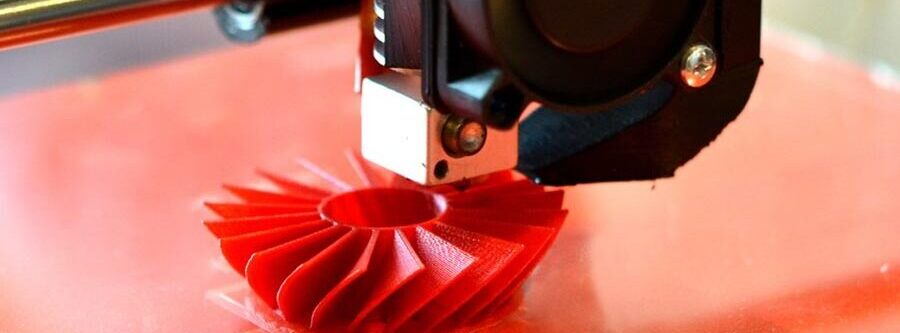
The printer feeds thermoplastic filament into a heated extrusion system. Once the material reaches the required processing temperature, it is extruded through a nozzle and deposited along a precisely controlled toolpath.
The first layer is deposited onto the build platform. The machine then continues to build the component layer by layer until the complete geometry is formed.
Each deposited layer bonds to the previous one, gradually creating the finished part.
Unlike conventional manufacturing processes, FDM does not require a dedicated mould or production tool. This allows an industrial 3D printing service to move directly from CAD data to physical production.
From Digital Model to Physical Part
One of the major advantages of FDM 3D printing is the direct connection between the digital model and the finished component.
A suitable CAD model can be prepared for production without the need to manufacture expensive tooling beforehand.
This makes single parts, prototypes, and low-volume production economically viable.
If the design changes, the digital model can simply be updated. The revised version can then be manufactured without modifying or replacing a physical production tool.
This flexibility makes FDM especially valuable in engineering development, where several design iterations may be required before the final version is approved.
It also allows product improvements and modifications to be introduced quickly during low-volume production.
Print Orientation
Print orientation is one of the most important parameters in industrial FDM manufacturing.
Because components are built layer by layer, their mechanical properties can be direction-dependent.
The expected loading direction should therefore be considered before printing begins.
The same component manufactured from the same material can perform differently depending on its orientation during production.
Orientation also influences:
- support material requirements,
- production time,
- surface quality,
- layer loading direction,
- dimensional accuracy,
- and manufacturing cost.
For functional parts, the ideal orientation should therefore be selected according to the intended application rather than simply choosing the shortest print time.
Layer-by-Layer Manufacturing
FDM differs fundamentally from subtractive production technologies.
In conventional CNC machining, material is removed from a larger block until the required geometry is produced.
FDM uses an additive process.
Material is deposited only where it is required, gradually building the component from individual layers.
This manufacturing principle enables internal cavities, hollow sections, integrated reinforcement structures, and complex geometries that may be difficult or uneconomical to manufacture using traditional methods.
Component weight and material consumption can also be reduced by designing the internal geometry specifically for additive manufacturing.
Layer Height
Layer height directly influences the balance between surface quality and manufacturing speed.
Smaller layer heights produce finer details and smoother surfaces but require more individual layers, increasing total production time.
Larger layer heights allow faster manufacturing and can be particularly useful for larger industrial parts.
The appropriate layer height depends on the purpose of the component.
A visual prototype may require a finer surface finish, while a functional internal machine component may be optimized primarily for mechanical performance, cost, and production time.
For industrial FDM 3D printing, the objective is not always to use the smallest possible layer height, but to find the most efficient setting for the required function.
Wall Thickness and Infill
FDM components do not necessarily need to be completely solid.
Internal structures can be created between the external walls of the component, reducing both material consumption and weight.
The internal structure can be adjusted according to the expected mechanical requirements.
For many engineering applications, wall thickness and shell design are at least as important as infill percentage.
A component with appropriately designed walls and internal reinforcement can often achieve the required strength without being manufactured with 100% solid infill.
This is one of the key advantages of FDM additive manufacturing: material can be strategically placed where it contributes most effectively to the structure.
Support Structures
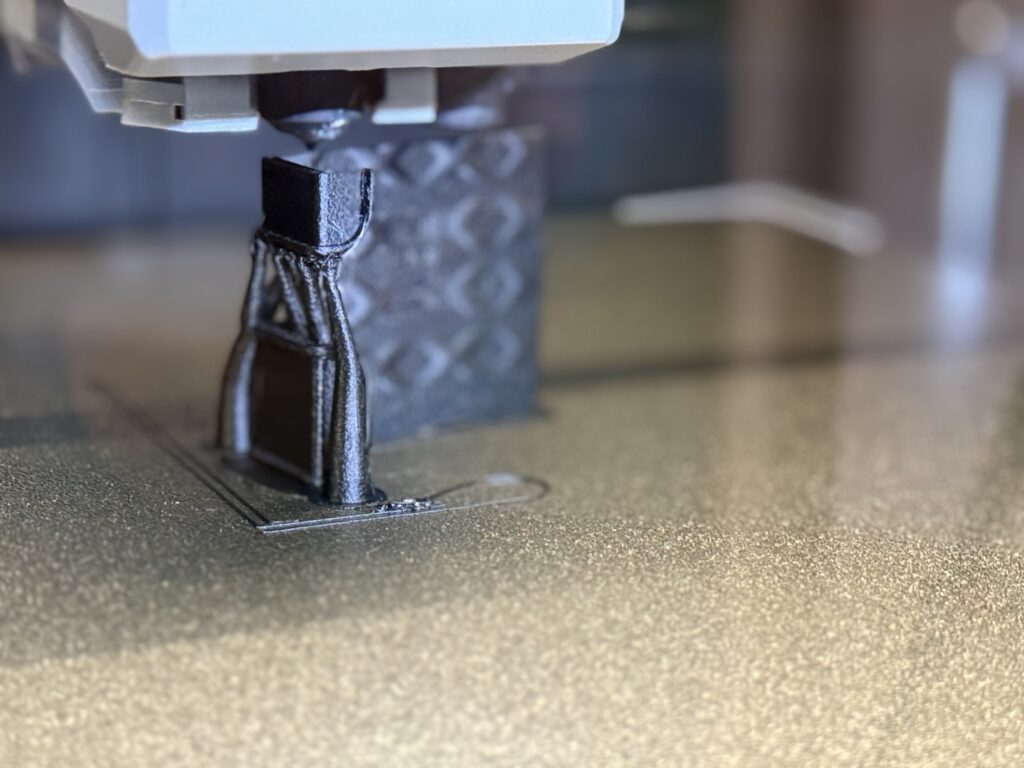
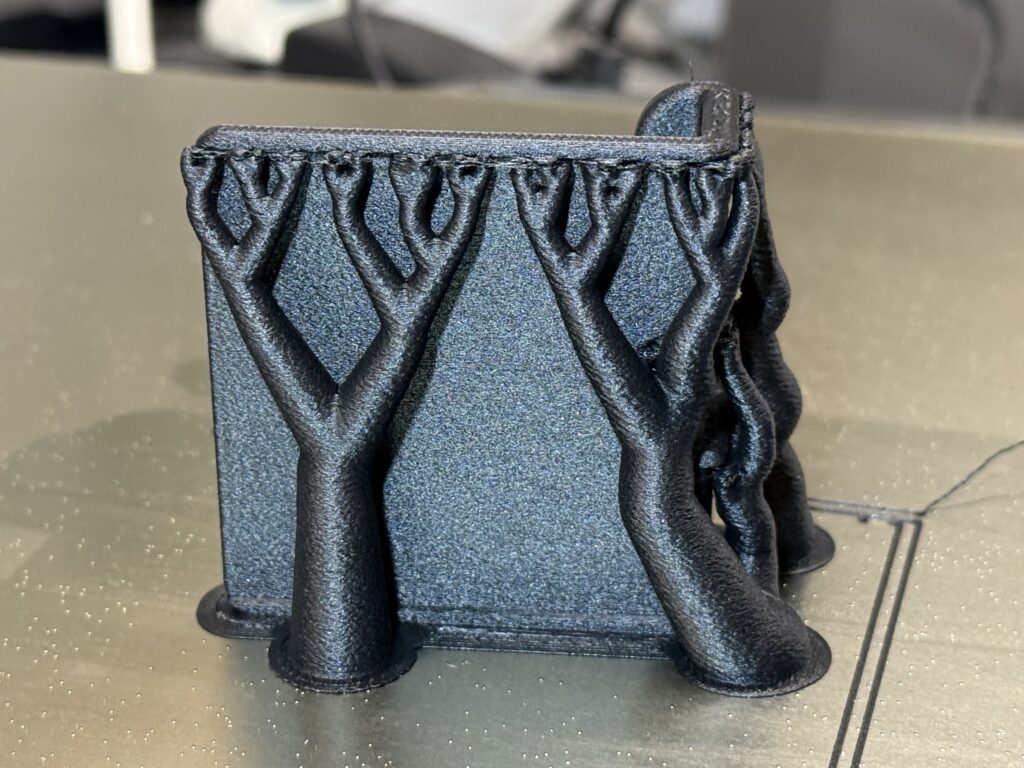
Certain geometries require temporary support structures during production.
An FDM printer cannot deposit every feature freely into unsupported space. Large overhangs, bridges, complex openings, and some internal geometries may therefore require additional support material.
These temporary structures are removed after printing.
However, good design and correct part orientation can significantly reduce the amount of support material required.
Reducing support structures can provide several benefits:
- shorter production time,
- reduced material use,
- less post-processing,
- and improved surface quality.
For this reason, manufacturing requirements should ideally be considered during the design phase.
Dimensional Accuracy and Tolerances
FDM technology can achieve good dimensional accuracy, particularly when the production process is correctly optimized.
However, several factors influence the final dimensions of a printed component.
These include:
- material shrinkage,
- processing temperature,
- machine accuracy,
- component size,
- print orientation,
- cooling conditions,
- and part geometry.
Critical mating surfaces, holes, shafts, and assembly interfaces therefore require appropriate design tolerances.
Where tighter tolerances are necessary, selected surfaces or holes can be finished after printing using mechanical post-processing.
This allows FDM manufacturing to be combined with traditional machining methods when required.
Enclosed and Heated Build Environment
The printing environment has a major influence on the quality of technical components.
For larger parts and engineering thermoplastics, an enclosed or temperature-controlled build chamber can significantly improve production stability.
Maintaining a controlled temperature reduces thermal gradients within the printed component.
This can help to:
- reduce warping,
- improve interlayer bonding,
- increase dimensional stability,
- improve repeatability,
- and support reliable production of larger parts.
Temperature control becomes especially important as part size increases or when more technically demanding materials are used.
For this reason, professional industrial FDM 3D printing often relies on enclosed and actively controlled production environments.
Large-Format FDM 3D Printing
FDM technology can be scaled far beyond small desktop components.
Industrial systems can manufacture parts several hundred millimetres in size, while large-format platforms can produce components approaching or exceeding one metre. This creates opportunities for applications that would otherwise require expensive tooling or the assembly of several smaller components.
Typical large-format applications include:
- machine housings,
- ducting,
- transportation components,
- industrial covers,
- manufacturing aids,
- tooling,
- fixtures,
- and large functional prototypes.
As component size increases, process planning becomes increasingly important.
Thermal expansion, shrinkage, warping, wall thickness, orientation, and production time must all be considered during manufacturing preparation.
Functional Prototypes
FDM 3D printing is widely used for functional prototyping.
Unlike purely visual models, functional prototypes can be designed to evaluate how the component behaves in its intended environment.
They can be used to test:
- fit,
- assembly,
- movement,
- interfaces,
- geometry,
- accessibility,
- and mechanical behaviour.
This allows potential design problems to be identified before committing to expensive tooling or full-scale production.
Multiple design versions can also be manufactured quickly, allowing engineers to compare alternatives physically rather than relying exclusively on digital models.
Low-Volume Production
Low-volume production is one of the key areas where an FDM 3D printing service can provide significant economic advantages.
Traditional plastic production methods such as injection moulding often require substantial initial tooling investment.
FDM production eliminates this tooling requirement.
This makes it possible to manufacture one-off parts, short production runs, and in some applications even series of several hundred components without dedicated moulds.
The technology is particularly useful for products that undergo frequent revisions.
A design modification only requires an updated digital model.
The next production batch can immediately incorporate the revised geometry.
This makes FDM particularly effective for evolving products, specialized machinery, and custom industrial systems.
Manufacturing Aids and Tooling
Manufacturing aids represent one of the most valuable industrial applications of FDM technology.
Examples include:
- assembly fixtures,
- positioning tools,
- drilling guides,
- jigs,
- inspection fixtures,
- protective elements,
- tool holders,
- custom brackets,
- and production-line accessories.
These components are often required in very low quantities.
Manufacturing them conventionally from metal or machined plastic can therefore be disproportionately expensive.
FDM additive manufacturing allows these tools to be produced quickly and modified when production requirements change.
If a fixture is damaged or the production process is updated, a revised component can be manufactured directly from the digital file.
Custom and Obsolete Replacement Parts
Industrial equipment often remains in operation long after certain original components are no longer commercially available.
FDM 3D printing can provide an effective solution for suitable replacement parts.
Existing components can be reverse-engineered from measurements, technical drawings, or 3D scanning data.
The resulting digital model can then be prepared for additive manufacturing.
A replacement component does not always have to be an exact reproduction of the original.
During redesign, it may be possible to:
- reinforce weak areas,
- modify wall thickness,
- improve interfaces,
- correct previous design limitations,
- or optimize the geometry specifically for FDM production.
This approach can be particularly valuable for maintenance departments, older machinery, transportation equipment, and custom industrial systems.
Post-Processing
FDM components can undergo additional processing after printing.
The required operations depend on the function, geometry, and final quality requirements of the part.
Typical post-processing operations include:
- support removal,
- deburring,
- sanding,
- hole finishing,
- drilling,
- thread cutting,
- threaded insert installation,
- and assembly.
Heat-set threaded inserts can also be installed in many thermoplastic components.
These provide durable metal threads inside the printed part and allow repeated assembly and disassembly.
Printed components can therefore be combined with screws, bearings, inserts, shafts, and other mechanical hardware to form complete functional assemblies.
When Should FDM Technology Be Used?
FDM 3D printing is particularly suitable when:
- low or medium quantities are required,
- fast prototyping is important,
- dedicated tooling is not economically justified,
- the design changes frequently,
- complex geometries are required,
- custom parts are needed,
- replacement components must be produced quickly,
- or large plastic components are required.
For very high-volume manufacturing of simple components, traditional production technologies such as injection moulding may remain more economical.
The main advantages of FDM are flexibility, rapid implementation, low initial tooling cost, broad geometric freedom, and direct manufacturing from digital data.
FDM Manufacturing Process
A typical FDM production project begins with an evaluation of the digital model.
The complete workflow generally includes:
- geometry and manufacturability review,
- material selection,
- definition of print orientation,
- configuration of layer height and production parameters,
- manufacturing,
- support removal,
- required post-processing,
- final inspection.
Correct production preparation is a fundamental part of a reliable FDM 3D printing service.
By selecting suitable orientation, wall structure, support strategy, and manufacturing parameters, mechanical performance can be improved while reducing production time and material consumption.
FDM 3D Printing at POLYFORGE-AM
POLYFORGE-AM provides industrial FDM 3D printing for functional prototypes, custom engineering components, manufacturing aids, replacement parts, and low-volume production.
Our FDM 3D printing service approaches every project as a complete manufacturing task rather than simply a printing operation.
Before production, we evaluate the geometry, orientation, intended application, and manufacturing requirements of the component.
This allows the production strategy to be adapted to the final function of the part.
Our FDM additive manufacturing capabilities can be used for both individual engineering components and repeatable low-volume production.
As an industrial 3D printing service, POLYFORGE-AM focuses on practical manufacturing applications where flexibility, engineering materials, short lead times, and digital production can provide a clear advantage over conventional manufacturing methods.
Detailed information about available thermoplastics and their properties can be found on our dedicated Materials page.
Planning an FDM 3D Printed Part?
Send us your 3D model or technical drawing together with the required quantity and intended application.
Based on the geometry and operating requirements, we can define an appropriate manufacturing strategy, production parameters, and material solution for the project.
POLYFORGE-AM – industrial FDM 3D printing from functional prototypes to end-use components.